A financial projection is only useful when it changes a decision. The strongest business owners use their numbers to decide who to hire, when to raise prices, and where profit is leaking, then manage to those numbers every week.
That was the message Heide Olson, Founder and CEO of All In One Accounting, brought to Financial Resource Management for Entrepreneurs at the University of St. Thomas Schulze School of Entrepreneurship this fall. Her lecture, “From Spreadsheet to Steering Wheel,” walked students through how real businesses build and use projections, and what she learned building her own.
Where do the best business opportunities come from?
The strongest opportunities sit where a real, recurring problem meets something you are uniquely equipped to solve. That is the “why now, why us” investors want to hear, and it is how All In One Accounting started.
Heide graduated from St. Thomas with a BA in Accounting, went to work at CPA firms, and earned her CPA license. Along the way, friends asked for help with their business accounting and taxes, and she kept saying yes. Those side projects kept showing her the same problem.
Every year, entrepreneurs and nonprofits brought messy year-end books to the CPA firm. The books got cleaned up, the taxes and audit got done, and the next year they were right back. Nobody was solving the day-to-day accounting problem, so leaders missed the chance to make data-driven decisions in real time. Heide started All In One Accounting in her basement to change that.
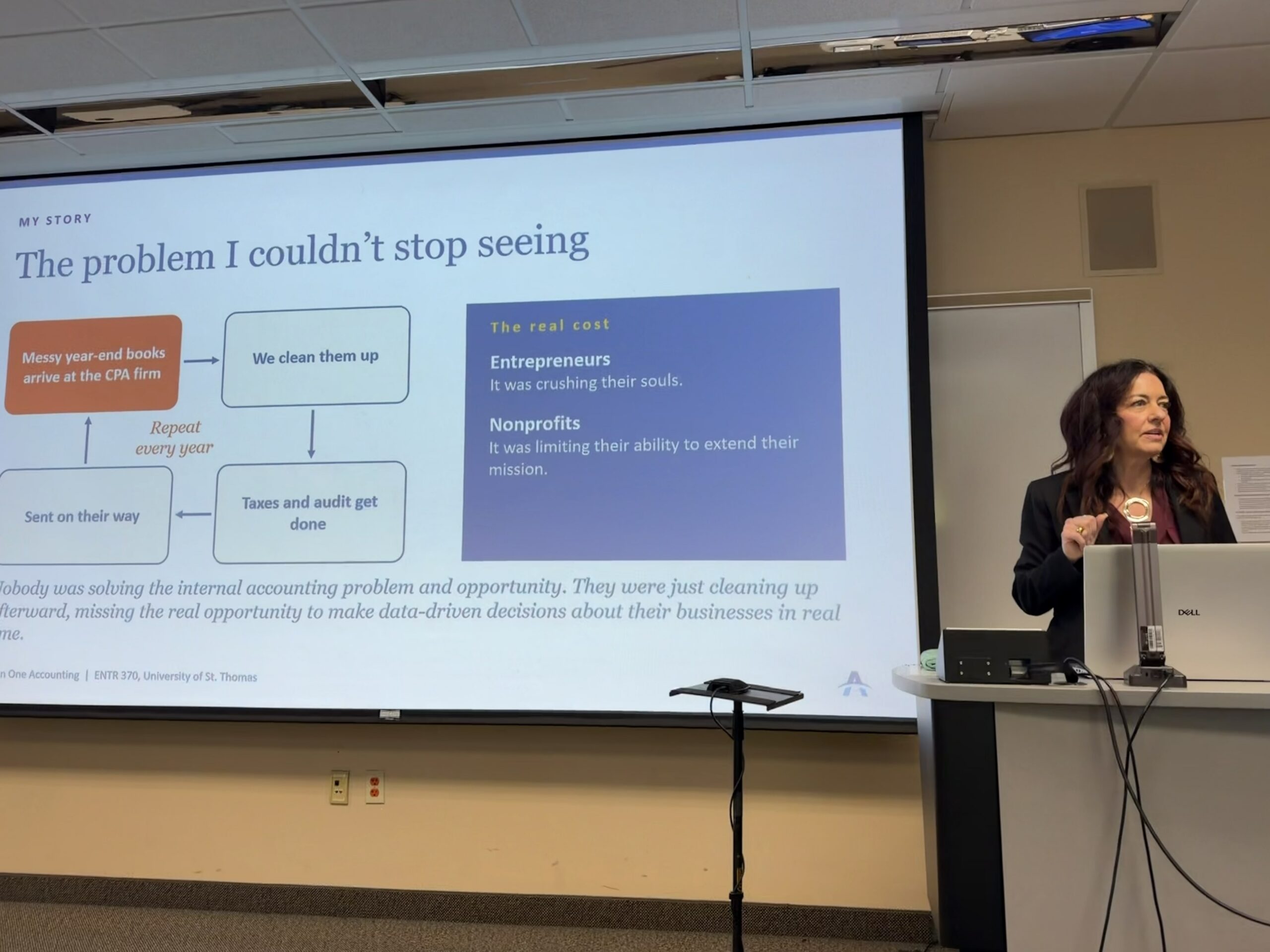
“It wasn’t a spreadsheet that started AIOA. It was seeing the same problem year after year and knowing I could solve it.”
Heide Olson, Founder & CEO
Projections only matter with a system behind them
A projection is a plan, and a plan needs a weekly rhythm to stay on track. Heide described the early years of the business as slow growth, until the company implemented EOS®, the Entrepreneurial Operating System®, in 2011.
EOS gives a leadership team a weekly Scorecard™ of the handful of numbers that show whether the business is on track. After AIOA adopted it, the team grew from 9 people to more than 100. Her advice to students: the numbers you project only matter if you have a system to manage to them every week. We run on EOS® too, and so do many of the businesses we serve.
How should you build a financial projection?
Start with last year’s actuals, then give every line an assumption and every assumption a reason. Real history beats a blank page.
- Start with last year’s actuals. Your own history is the most honest starting point you have.
- Plan overhead first. Rent, software, and administration are mostly fixed and easy to identify.
- Spend the most time on cost of goods sold. This is what it truly costs to deliver each dollar of revenue, and it is where margins are won or lost.
Heide’s first rule was simple: know your margins and how you make money, and be relentless about understanding and tracking them. Targets should come from industry analysis and your own actual results, never a guess.
What does a projection reveal about a business?
Walking down last year’s numbers shows exactly where profit is going. Heide used an illustrative $2 million professional services firm to show students what to look for.
Gross Margin
Against a 50% target. Delivery costs too much.
Overhead
Mostly fixed. Easy to see, plan, and hold.
Net Income
Against a 20% target. The gap lives in delivery costs.
In this example, overhead is predictable. The real story is $120,000 in outside contractors, an expensive line that raises the question of whether that work could come in-house.
How do you set a budget that hits your goals?
Pick the target, then ask what would have to be true, line by line, to reach it. Then decide which of those levers you actually believe.
For the sample firm, a first-pass budget with 6% more clients, a 4% price increase, and contractor work brought in-house moves gross margin from 44% to 48% and net income from 9% to 15%. That is better, but short of the goal. A stretch budget closes the gap with more clients, a bigger price increase, one new hire to carry the growth, and tight control on overhead.
Heide reminded students that the math underneath is simple. The only way to increase profitability is to increase revenue or decrease expenses, and every line in a budget is one or the other.
Why does protecting your margins matter as you grow?
Overhead does not have to grow as fast as revenue, so every new dollar earned at a healthy margin drops more to the bottom line. In Heide’s illustrative model, revenue grows 15% a year while overhead grows about 5%.
Revenue
Revenue roughly doubles over the projection
Net Income
Net income grows nearly sevenfold
Overhead
Overhead shrinks as a share of revenue
This only works when margins hold. Grow revenue at poor margins and the business gets bigger without getting more profitable.
What financial lessons matter most for entrepreneurs?
After more than two decades of building All In One Accounting, Heide closed with the lessons she shares most often with clients.
- Watch margins like a hawk. They tell you first when something is wrong.
- Know what they should be. Set targets from industry data and your own experience.
- Zero in your scorecard. Your weekly scorecard and monthly financials should track those numbers.
- Hire to fill the gaps. Know what you are good at and what you are not, then bring in people who cover the rest.
- Borrow only if you have to. Heide bootstrapped AIOA and was always able to reinvest.
- Do not back yourself into a corner. Be able to skip a salary or put money in, because you will be tested.
- Remember that culture eats strategy for breakfast. Your people are the key in every business.
“The numbers always tell a story, but never the whole story.”
Heide Olson, Founder & CEO
Pressure-test your own projection
The same questions Heide gave students work for any business owner building next year’s budget.
- Did you start from last year’s actual numbers?
- Does every line have an assumption, and every assumption a reason?
- Did you spend the most time on what it costs to deliver your work?
- Does your overhead grow slower than your revenue?
- Do your scorecard and monthly financials track your margins?
Questions business owners ask about financial projections
How do business owners use financial projections to make decisions?
Business owners use financial projections to decide who to hire, when to raise prices, and where profit is leaking. A projection built from last year’s actual results shows which lines are off target, such as delivery costs that are too high or contractor spending that could move in-house. Heide Olson, Founder and CEO of All In One Accounting, teaches that a projection only matters when there is a system to manage to it every week. That usually means a short scorecard of key numbers and monthly financials that track margins, so leaders can adjust course before a small gap becomes a big one.
Where should I start when building a business budget?
Start with last year’s actual numbers, then build the new budget line by line with a stated assumption behind every line. Real history is a more honest starting point than a blank spreadsheet. Overhead such as rent, software, and administration is usually easy to identify and plan. Cost of goods sold deserves the most time, because it shows what it truly costs to deliver each dollar of revenue and is where margins are won or lost. At All In One Accounting, every client projection starts this way, then compares each line to targets set from industry data and the business’s own experience.
What gross margin and net income should a business target?
The right targets depend on your industry and your own history, so they should come from industry analysis and your actual results. Benchmarks for similar businesses show what is realistic, and your past performance shows what your team can deliver. Once targets are set, compare last year’s numbers against them to find the gap, then ask what would have to be true to close it, such as a price increase, more clients, or lower delivery costs. Every lever is a way to increase revenue or decrease expenses, the only two paths to higher profitability. All In One Accounting builds client projections around targets set this way.
Why does net income grow faster than revenue in a healthy business?
Net income can grow faster than revenue because overhead does not have to grow at the same rate. In an illustrative model Heide Olson shared with University of St. Thomas students, revenue grows 15% a year while overhead grows about 5%. Revenue roughly doubles, but net income grows about 6.8 times, and overhead falls from 35% to 21% of revenue. The condition is protecting gross margin as the business grows. A company that adds revenue at poor margins gets bigger without getting more profitable, which is why tracking margins every month matters as much as chasing growth.
When should an entrepreneur hire to fill gaps on their team?
An entrepreneur should hire to fill gaps once they are clear about what they do well and what they do not. This is a core idea in EOS, the Entrepreneurial Operating System, which encourages founders to let go of work outside their strengths and put the right people in the right seats. A projection helps time the hire by showing whether the revenue and margins can carry the new cost. Heide Olson, Founder and CEO of All In One Accounting, counts it among the most important financial lessons from building her company.
Where this connects to how we work
Heide’s lecture describes the work our teams do with clients every month. Through our Accounting Clarity® process, accountants, controllers, and CFOs work together to establish accurate baselines, close the books on time, and deliver the budgets and forward-looking insights that leaders need to Support Profitable Growth.
If you are wondering whether your business needs that leadership full-time or fractionally, our guide to choosing a fractional CFO or a full-time hire walks through the decision by revenue stage.

Heide is a CPA and a University of St. Thomas graduate with a BA in Accounting. She founded All In One Accounting to give entrepreneurs and nonprofits the day-to-day financial support she saw missing at CPA firms.
She bootstrapped the company from her basement, and today All In One Accounting runs on EOS® with a team of more than 100 accountants, controllers, and CFOs.
Do your numbers help you steer the business?
If your projections live in a spreadsheet nobody opens after January, you are making decisions without a map. Our fractional controller and CFO teams help you build a budget you believe in and track it every month.